
Give us a call M-F (6am-10pm CT), Sat-Sun (8am-7pm CT)

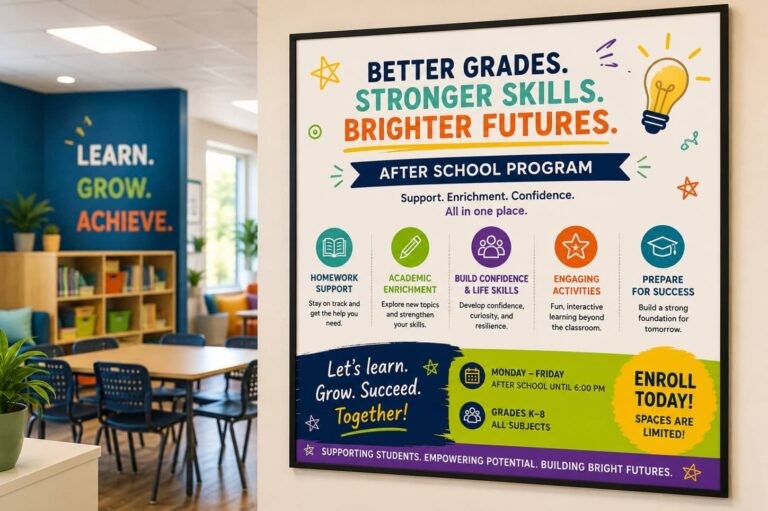
Parents searching for after-school support often have to make quick choices while juggling school pickup, errands, and family time. What really helps them is having clear information in the right place, and just the right details to keep their interests piqued.
If you run a math or reading center, your printed materials can do more than just advertise your services. With the right structure, they can guide the parents, making it easier for them to understand your programs and feel confident about signing up.
This guide will help you organize your print materials, so parents notice them, making your learning center a more appealing choice for their children’s after-school activities.
Most people have only about 8 seconds to notice and take in a message when they see a sign as they walk by.
During that brief moment, people scan quickly rather than read every word. Clear headings, simple language, and a strong visual layout help parents understand your programs and decide whether they want to learn more.
When your materials are clear and well-organized, they help you:
According to the Sign Research Foundation, about 17% of customers stopped at a business they hadn’t planned to visit just because they saw its sign. This shows how clear, visible signs can help attract more walk-in visitors.
Parents absorb information more easily when signs follow their natural path through your learning center. Organize materials by location: start with storefront displays, then move to your office space, and finally to take-home handouts. Each printed sign and piece of promotional material should address parents’ specific questions. This step-by-step approach improves visibility, reduces confusion, and helps parents move from initial interest to confident enrollment decisions.
Right now, parents want to know one thing: “Is this relevant for my child?”
Your storefront needs to answer that question clearly and quickly.
Materials to use
What to communicate
Focus on a clear message for your target audience. Always dictate who you help and what you offer.
Examples:
Keep your messages short. Usually, 6 to 10 words is enough. Use large fonts and strong contrast so people can read them easily, even from a distance or while passing by.
The goal is not to list every program. Instead, help parents quickly see that your center is right for their child.
When parents show interest, you can use your window designs to clearly explain what you offer.
Treat it like a quick program overview that parents can read in a few seconds.
Here are some signs that work well for your office windows:
Tips for organizing your programs
Group your services into easy-to-understand categories:
Each program should have a short description, the grade levels it serves, and a clear outcome.
Example:
Why this works
At this stage, parents do not need full explanations. They just want to quickly see which option fits their child. Clear categories and brief descriptions help them do that.
Layout matters too. Spacing, font size, and alignment all make it easier for parents to scan your signs. Using some tips from school signage, like good placement and clear visibility, can help your window displays stand out and be easy to read.
When parents walk into your learning center, they are already thinking about your programs. Clear signs and printed materials can help them see their options and feel more confident about signing up.
Program posters work best when they share simple, easy-to-read information instead of giving too many details. Each poster should quickly show the program’s value and who it is for.
What each poster should answer:
Example:
Homework Help Program
Keeping all posters consistent also makes things easier for parents. When every program uses the same layout, parents can more easily compare services without getting confused by different formats or designs.
This organized approach saves time, reduces confusion, and helps parents feel more confident when making decisions.
Many parents like to review information at home before deciding. Flyers, brochures, and business cards help your learning center stay memorable after their visit and give families something to look back on later.
Take-home materials are most helpful when they guide parents through the decision process, not just give lots of information. Clear organization makes these materials easier to understand and more useful for families.
Suggested brochure structure:
Front panel
Inside panels
Back panel
QR codes can help parents quickly find:
Looking at real examples of QR codes on school and learning center signs can give you ideas for connecting printed materials to digital actions.
Business cards are more helpful when they clearly share important information at a glance.
Good business cards should include:
Even the best materials become better when you use them at the right time and place.
For most tutoring centers, the best time is between 3 PM and 6 PM. During these hours, parents are picking up their children and often think about extra academic help.
How to get the most out of these hours
Clear signs and printed materials make it easier for parents to find their way around your learning center. When your displays, signs, brochures, and take-home materials all match, families can understand your programs and make choices with confidence. A consistent approach also makes the parent’s experience better and helps your enrollment grow over time. With print materials designed by PrintPlace, your learning center can explain its services more clearly and connect with new families
PrintPlace’s mission is to provide customers with unparalleled printing services through the knowledge and expertise of its employees.