
Give us a call M-F (6am-10pm CT), Sat-Sun (8am-7pm CT)

Key Points:
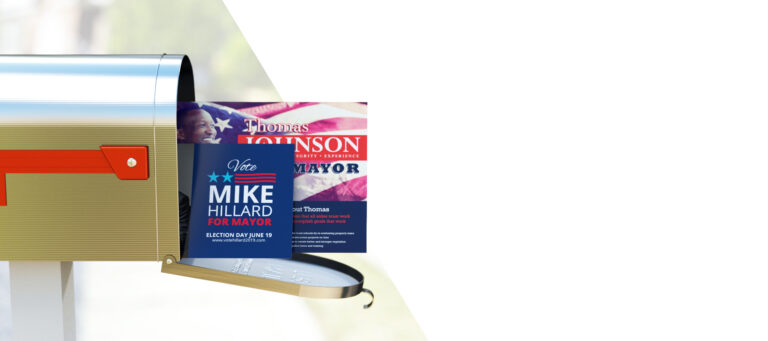
Despite the prevalence of digital advertising and social media, direct mail remains an effective tool in modern political campaigning. Voters generally view printed campaign materials as credible, memorable, and trustworthy when they feature a professional design and premium finishes. Furthermore, strategic and timely distribution also play a key role in the success of political mailers, as it helps increase name recognition and reinforce values.
Mailers take many forms, but postcards, flyers, and brochures are the most popular formats used in political campaigns. Learn more about them below.
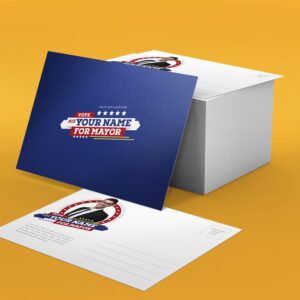
Postcards are best for short, impactful messages and memorable slogans, such as “Vote on November 8,” “Endorsed by Local Teachers,” or “Lower Taxes, Stronger Schools.” They also suit campaigns with limited budgets because they are easy to distribute via postal services.
Their simple format also makes them perfect for door-to-door distributions, mass mailings, and rapid-response messaging.
Standard Postcard Sizes
Using standard postcard sizes helps meet postal service requirements, minimizing extra fees and delivery issues (e.g., delays and returns). Smaller standard postcards may also qualify for reduced mailing rates.
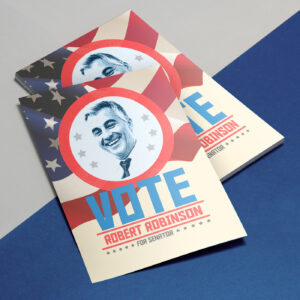
Flyers are single-sheet prints that are great for issue-focused communication. They are often used to explain policy positions and priorities and to promote campaign events and rallies.
They also work well for events, canvassing, and envelope inserts. Their flexibility makes them a staple for campaigns that need quick, high-volume distribution via direct mail or volunteer drops.
Standard Flyer Sizes
Standard flyer sizes slide easily into envelopes, thus potentially reducing postage costs. Moreover, they are easier and faster to print than custom formats, which is crucial during tight campaign timelines.
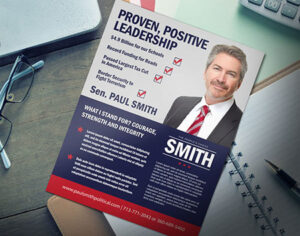
Brochures have more space than postcards and flyers, so they are excellent for complex policy proposals, storytelling (background and qualifications of candidates), and endorsements from community organizations or leaders. They are primarily designed for voters who need more detailed information.
A brochure’s multi-panel layout provides space for charts, photos, testimonials, and issue comparisons, which build credibility and trust.
Standard Brochure Sizes
Using standard brochure sizes is one way to keep production costs lower and ensure that the chosen fold style (e.g., tri-fold, bi-fold, or flat) is compact enough for mass mailings.
The design, print quality, materials, and finishes of political campaign mailers may influence how people perceive their message. Follow these best practices to ensure your print materials look professional and polished.
Direct mail is most effective when combined with smart targeting strategies that focus resources on receptive voters.
In most states, political parties, declared candidates, and official campaign committees can obtain a statewide voter file from the state or local election authority. This file typically includes voters’ names, registration status, addresses or precincts, and voting history. Using this file, you can identify likely supporters, swing voters, and low-propensity voters.
People are more receptive to print materials when they are highly personalized — i.e., they include voters’ names, addresses, and messages aligned with their beliefs and concerns.
Personalized mail consistently outperforms generic messaging, as readers respond more positively to materials that feel relevant and personal.
Geographic targeting means tailoring a campaign strategy by place (state, district, city, neighborhood, or even street) to reach the voters who matter most. This approach allows campaigns to target high-priority neighborhoods with consistent messaging, thus increasing name recognition and persuasion.
Timing plays a key role in the success of political campaign mailers. In general, they are most effective during the final 4-6 weeks before election day.
Frequency also matters, as sending too many mailers may put off voters. In most cases, 3–5 well-timed pieces deliver the best results.
| Campaign Phase | Timing | Message Focus | Ideal Format |
|---|---|---|---|
| Introduction | 6–8 weeks | Biography, values, name recognition | Postcards and flyers |
| Issue Messaging | 4–6 weeks | Policy positions and contrasts | Flyers and brochures |
| Early Voting Push | 3–4 weeks | Turnout reminders and voting details | Postcards and flyers |
Political campaign mailers remain reliable tools for reaching voters, especially when they come in the “right” format based on the purpose: postcards to deliver quick reminders, flyers to communicate issues efficiently, and brochures to offer in-depth persuasion for engaged voters.
The success of direct mail also depends on strong design and print quality, precise targeting, and strategic timing.
Ready to print your political campaign materials? PrintPlace offers premium postcards, flyers, brochures, door hangers, stickers, and posters, with fast turnaround times designed for time-sensitive campaigns.
PrintPlace’s mission is to provide customers with unparalleled printing services through the knowledge and expertise of its employees.