
Give us a call M-F (6am-10pm CT), Sat-Sun (8am-7pm CT)

Key Takeaways:
Street pole banners are commonly used for city branding, seasonal promotions, outdoor decorations, festivals, and business districts. They require precise installation to stay secure, look professional, and withstand wind, rain, and other outdoor elements.
You need a permit or authorization before installing them on public properties, such as city light poles, utility poles, or roadway infrastructure.
This guide covers the step-by-step process for installing a street pole banner correctly, ensuring it looks professional and pristine throughout the campaign.
Before starting the installation process, gather all necessary tools and equipment.
Materials:
Tools
Safety Equipment

Before installation, inspect the pole carefully, making sure it is free from cracks or corrosion. Next, look for potential hazards, such as power lines, tree branches, and traffic signs and lights.
Warning: Never install banners near utility poles and transmission towers without proper clearance and authorization.
Determine the exact placement of the banner. The goal is to make it visible from the roadway without causing inconvenience to drivers and pedestrians.
Next, use a measuring tape and an erasable marker to find the right bracket placement. You can also use a level to ensure the upper and lower brackets are perfectly aligned.
Most street pole banner systems use stainless steel bands to secure brackets to the pole. Wrap them around the pole exactly at the marked locations. Next, tighten them to remove any slack.
Tip: Avoid overtightening the mounting bands, as doing so may damage the pole or hardware.
Once the bands are tight and secure, install the upper and lower brackets, ensuring they are evenly spaced to keep proper tension on the graphic. Use a level to verify perfect alignment.
Slide the two pole pockets (they are sewn into the top and bottom edges of the graphic) into the upper and lower rods.
Carefully raise the banner assembly to attach the top and bottom rods to the hooks or clamps. Ensure the banner hangs evenly, with no excessive tension, slack, twists, or folds. The banner should be taut but still flexible enough to move slightly in the wind.
Tip: Creating proper tension helps reduce wear and prevents premature tearing.
Check every connection point before leaving the installation site, paying close attention to bracket fasteners, band clamps, rod connections, and screws. Tighten or adjust the tension if needed.
Here’s a checklist to ensure the banner is stable and secure.
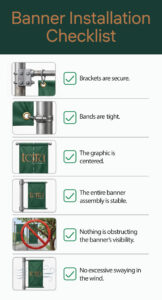
1. Uneven Bracket Placement: Misaligned brackets can cause twisting and poor visual appearance.
Solution: Use a measuring tape and a level (instead of just eyeballing) to ensure precise alignment.
2. Overtightened Bands: Excessive force may damage both the pole and the mounting hardware.
Solution: Readjust the bracket positions and re-tighten them to a safe, taut specification.
3. Ignoring Wind Load: Larger pole banners create strong wind resistance and require spring-loaded mounting systems.
Solution: For windy locations and larger banners, use spring-loaded brackets that allow the banner to flex, reducing the overall wind load.
4. Incorrect Hardware: Incompatible hardware may fail in outdoor conditions.
Solution: Use the mounting accessories that come with your pole banner. Although you can order “banner only,” it is generally not recommended to assemble your own DIY mounting system.
5. Ignoring Safety Procedures: Incorrect installation of street pole banners may result in accidents.
Solution: Always use proper protective equipment and secure a safe work zone.
By following this step-by-step installation guide and performing routine maintenance, your street pole banner system can remain secure, effective, and visually appealing throughout the campaign.
Allow your message to stand out with vibrant pole banners from PrintPlace.com. These banners are printed on tear- and weather-resistant vinyl materials that are available in various standard sizes and mounting options.

PrintPlace’s mission is to provide customers with unparalleled printing services through the knowledge and expertise of its employees.